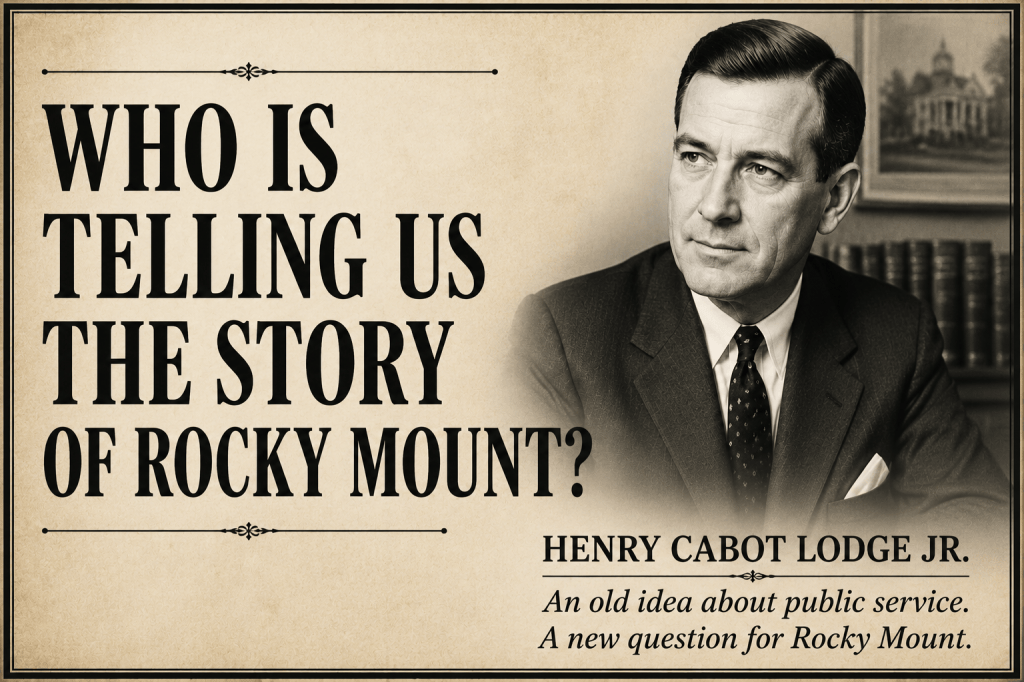
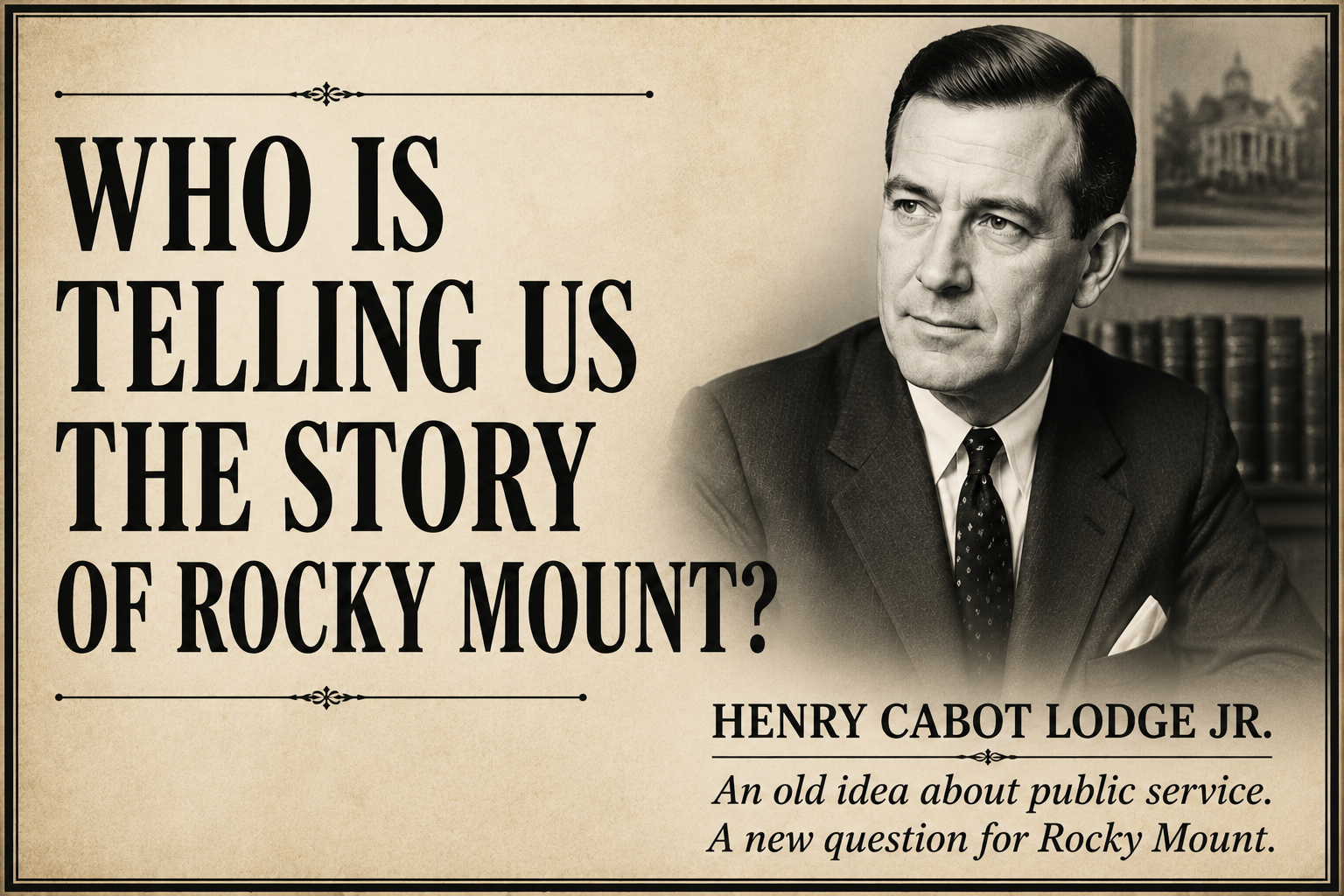
I have started the book, The Last Brahmin, Luke A. Nichter’s biography of Henry Cabot Lodge Jr., and I am already hooked.
Lodge belonged to an era of American leadership that I respect and long for once again. He was born to privilege, education, wealth and connections, but with those advantages came an expectation I deeply admire:
To those much is given, much is expected.
You served.
The men of Lodge’s world were raised to believe that privilege carried an obligation to country and that leadership came with duties beyond oneself.
Before opening the book, I researched the author.
Who is telling me this story?
I learned that Nichter is an archival historian, interested in going back to original documents and evidence, questioning assumptions that have hardened into accepted history.
His instinct seems to be less What have we always been told? and more:
What does the evidence say?
And there it was.
My Main Street thought.
Who is telling us the story of Rocky Mount?
A budget comes with a story.
A financial report comes with a story.
A development project, a utility problem, a decision to spend money, borrow money, demolish something or preserve something comes with a story.
Someone explains what happened, what it means and why a particular decision is the right one.
What if we borrowed the historian’s habit?
What does the evidence say?
Who supplied it?
What was considered?
What wasn’t?
Is there another reasonable interpretation?
Are we accepting something because it has been demonstrated to be true, or because it has been repeated often enough to sound true?
And are citizens allowed to question the storyteller?
Questioning a City Council decision is not disrespect.
Asking for the numbers is not an accusation.
Disagreeing with an elected official is not disloyalty to Rocky Mount.
It is citizenship.
We elect people to make decisions, and that authority deserves respect.
But respect does not require silence.
Historians routinely return decades later to the decisions of presidents, senators and governments. They examine the documents, compare accounts, question the accepted explanation and sometimes discover that the story we inherited wasn’t the whole story.
Why should citizens have to wait fifty years to ask those questions about their own government?
We are here now.
This is our city.
These are our decisions being made for us.
Henry Cabot Lodge reminds me that those entrusted with leadership have an obligation to serve.
Luke Nichter reminds me that those seeking the truth have an obligation to question.
Putting The Last Brahmin down for a minute I ask, Who is telling us the storyof Rocky Mount?
It is a good question when reading history but, it may be an even better one while we are living it.
Stepheny Forgue Houghtlin grew up in Evanston, IL. and is a graduate of the University of Kentucky. She is an author of two novels: The Greening of a Heart and Facing East. She lives, writes and gardens in NC. Visit her: Stephenyhoughtlin.com
View all posts by Stepheny Forgue Houghtlin