
Some thoughts on artificial intelligence, a changing world, and the courage to keep learning
Don’t be left behind.
Are you among those who have decided that artificial intelligence is something to worry about, criticize, or avoid altogether, without ever having tried it?
I have a suggestion. Give it a chance.
I have lived long enough to remember when television was going to ruin family life, calculators would keep children from learning arithmetic, microwave ovens were regarded with suspicion, and computers threatened to replace people and eliminate jobs. The Internet arrived, and with it came another round of predictions about the end of life as we knew it.
Well, look at us now.
Not every prediction was foolish, and not every concern was without merit. Technology has changed our lives in ways both good and bad. But imagine what we would have missed if we had refused to participate in those changes simply because we were uncertain of what came next.
Today, artificial intelligence has become the latest subject of considerable hand-wringing. We hear about privacy, misinformation, lost jobs, enormous data centers, demands on our electrical grid, and the possibility that machines will one day become smarter than the people who created them.
Those are legitimate concerns, worthy of serious attention. But somewhere between reasonable caution and outright rejection, I believe we are missing an important opportunity.
We can be concerned about the future without being afraid to participate in it.
I write a blog. For a while, I had a podcast. I take photographs with my phone, research the history of old houses and the people who lived in them, and spend a considerable amount of time following one question into another. I am not a technology expert, nor do I aspire to become one. But, I do pretty well for myself. I have simply learned to use the tools that suit my purposes.
Artificial intelligence has become one of them.
I have never purchased one of those fancy photographic programs to improve my pictures. Yet when I photograph the commercial architecture along Main Street in Rocky Mount, I invariably find a utility pole, a parked car, or some other modern intrusion spoiling the view of a beautiful old building.
Along comes ChatGPT.
I can ask it to remove the offending automobile or utility pole, and there before me is a much better look at the architecture I wanted people to appreciate in the first place. The building hasn’t changed. I have simply found another way to help people see it.
My research has benefited enormously. I have been led to sources, records, and historical references I would never have known existed. One discovery leads to another, and suddenly I am following a trail that would have been difficult, if not impossible, to find on my own.
That doesn’t mean I accept every answer without question. Artificial intelligence can be wrong, quite confidently wrong. Depending on what you’re working on you are best served if you verify the information. My depth of work can trust that lyrics or the whole poem is correct. It is a remarkable research companion for the likes of me.
There are the small pleasures.
I can remember the feeling a passage left with me while unable to recall the exact words. I can describe what I do remember, and like magic, there is the information, or at least a promising place to begin looking.
I find that delightful.
None of this means I have abandoned books, stopped thinking for myself, or surrendered my imagination to a machine. On the contrary, AI has given me additional ways to pursue the interests I already have.
And isn’t that what technology, at its best, is supposed to do?
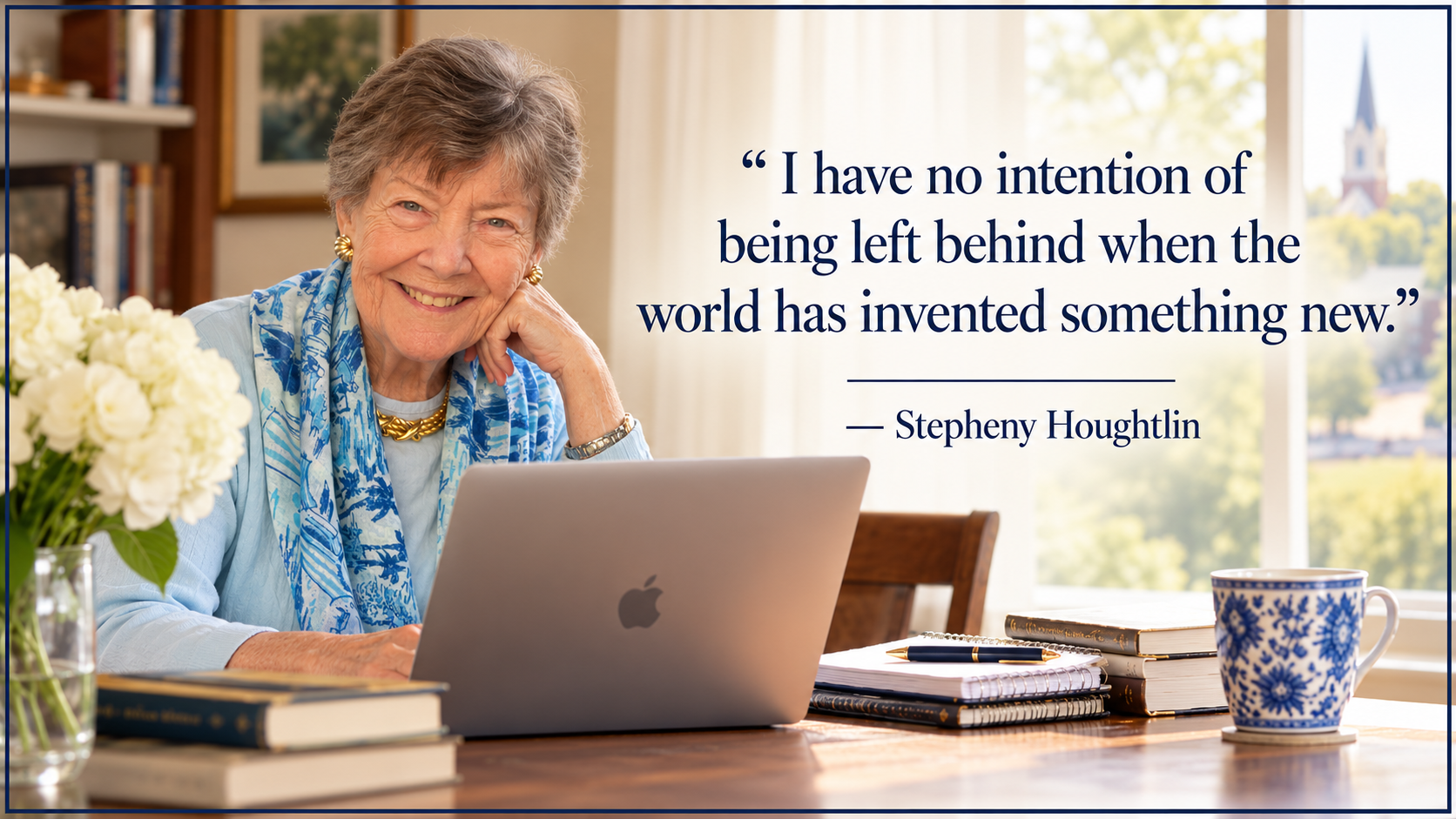
There is also the sheer pleasure of discovering what AI can create. I recently gave ChatGPT a photograph of myself and asked it to imagine an illustration reflecting my work with the House Biography Series. The result brought together so many of the things I love.