For weeks, much of the public discussion surrounding Ward 1 has centered on personalities.
Some defend Councilman Andre Knight passionately.
Others criticize him just as passionately.
Social media has done what social media often does, reducing a complicated civic question into opposing camps.
The issue is not whether a councilman is liked.
The issue is not whether he has loyal supporters.
The issue is not whether critics are fair.
The real question is what residents have experienced after more than two decades of representation.
Twenty-three years is a long time.
It is long enough to watch children grow up and become parents themselves.
It is long enough to see neighborhoods improve, or decline.
It is long enough for a vision to take shape and become visible.
And that raises an important question about the role of a ward councilman.
What is a councilman expected to do?
Certainly, no councilman can solve every problem. He cannot personally renovate every house, recruit every business, repair every sidewalk, or eliminate every challenge facing a neighborhood.
The responsibility for Ward 1 struggles belong not only to the ward representative but also to mayors, city managers, planning staffs, economic development officials, and city councils that approved budgets and priorities.
That doesn’t remove accountability from Andre Knight, but it also places accountability on leadership over time.
Leadership matters.
Vision matters.
Advocacy matters.
Someone must be willing to stand up for a neighborhood, speak for its residents, and continually push for improvement.
Perhaps the best way to think about that responsibility is through the image of a gardener.
Every neighborhood deserves a gardener.
Someone who sees potential before others see it.
Someone who notices problems before they become permanent.
Someone who advocates, cultivates, and inspires.
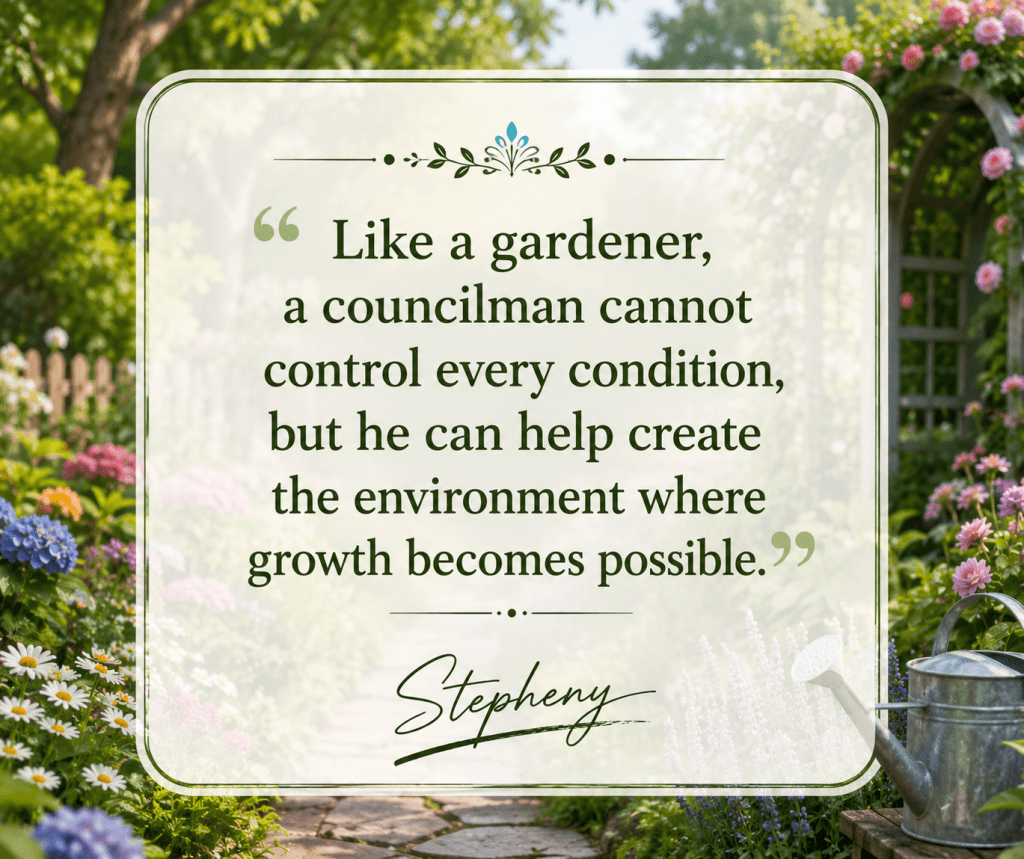
A ward councilman is not the owner of the garden.
Not the only worker in the garden.
Not responsible for every storm, drought, weed, or insect.
A gardener cannot make a flower bloom.
However, when a garden struggles year after year, citizens have every right to question the gardener.
That question is not personal.
It is civic.
It is not about whether the gardener is liked.
It is about whether the garden is flourishing.
That distinction changes everything.
Every successful garden begins with a vision.
The gardener sees what others do not yet see. He imagines beauty where others see weeds. He imagines possibility where others see neglect. Year after year, he returns to the same ground, nurturing, encouraging, and cultivating.
If you mulch for three years, dirt becomes soil.
A neighborhood deserves no less.
The question is not whether the gardener is admired.
The question is not whether the gardener has loyal supporters.
The question is not whether criticism of the gardener is fair or unfair.
The question is simple.
What does the garden look like?
After twenty-three years, citizens have every right to ask.
Has the neighborhood become stronger?
Has opportunity increased?
Have conditions visibly improved?
Has a clear vision emerged?
Has the garden flourished?
These are not personal questions. They are civic questions.
They are questions asked not out of anger, but out of concern for the people who call the neighborhood home.
Because every resident deserves more than promises, and the same old rhetoric about plans.
And after twenty-three years, the condition of the garden can speak for itself. The Ward 1 garden is asking for better care to survive.


It’s hard for one’s garden to flourish with an absentee gardener.
LikeLike
Andre is an invasive weed overtaking a once loved garden. The garden is dying from neglect.
Rodd
LikeLike
I see the ward 1 constituents as the seeds, their structures as their environment. Mr. Knight is the fertilizer for those seeds and the councIl as a whole are the other required nutrients to ensure healthy environment and constituents grow.
LikeLike
I like this a lot, rewording the Ward 1 garden metaphor. Thanks!
LikeLike