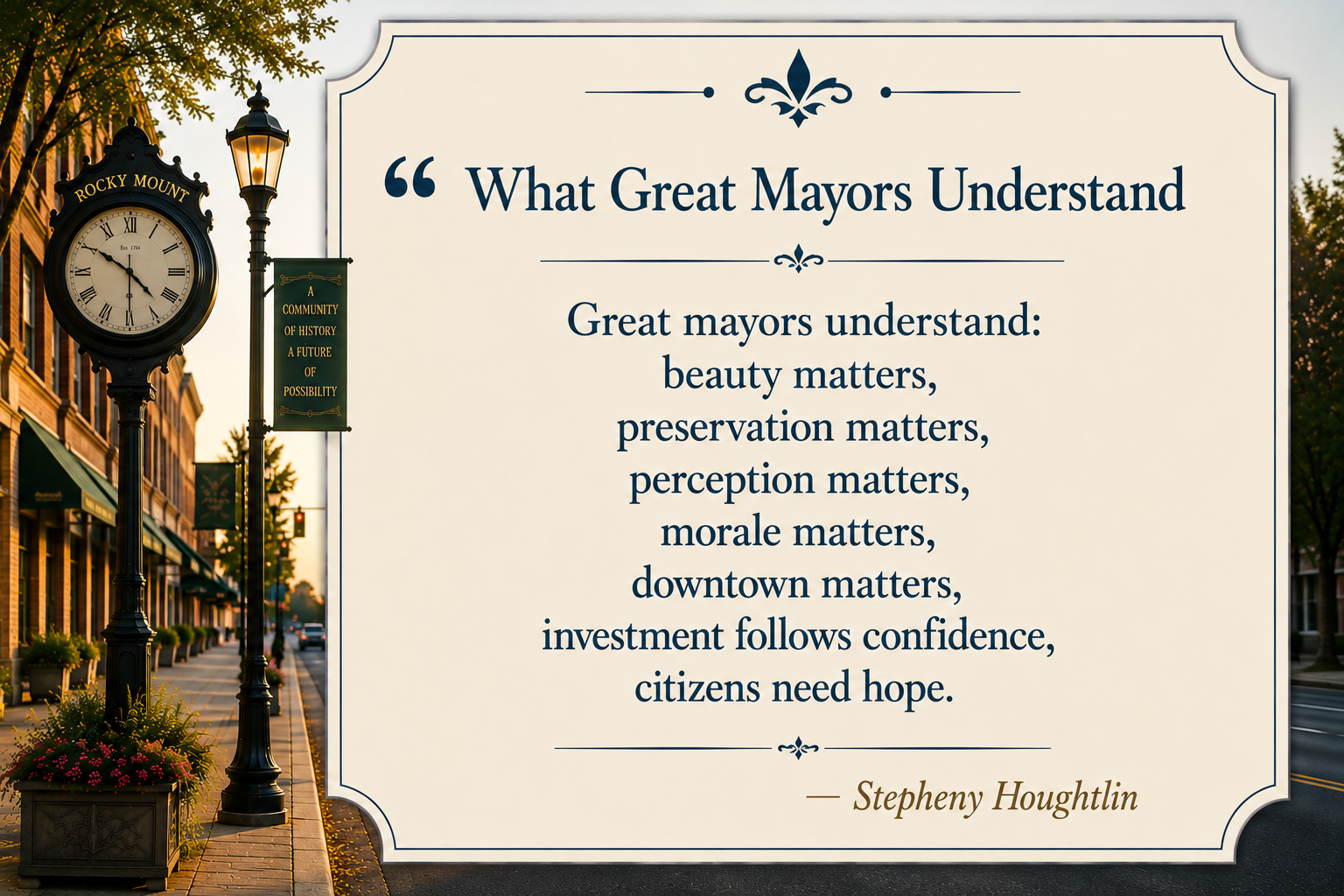
Mayor Sandy Roberson will not seek reelection in 2027, and that reality causes me to think about the kind of mayor Rocky Mount will need in the years ahead. The complexity of the city has grown, and what the city now expects from its mayor has changed with it.
Rocky Mount operates under a council-manager form of government. The city manager oversees the daily administrative operations of the city, while the mayor serves as the public face of leadership, presiding at meetings, building relationships, encouraging development, and helping establish the direction and tone of the city itself.
Rocky Mount was never structured around the idea of a strong executive mayor managing the day-to-day operations of government. Under the council-manager system, that responsibility belongs to a professional administration. (Which is another things we need to discuss.)
Yet modern cities increasingly ask far more from their mayors.
Today’s successful mayors become constant ambassadors for their cities, visible advocates for economic development, relationship builders with business leaders and developers, promoters of downtown investment, encouragers of neighborhood revitalization, and recognizable voices shaping public confidence in the community’s future.
Mayor Sandy Roberson’s willingness to devote enormous time and energy to the position has benefited Rocky Mount greatly. His circumstances allow this. Anyone watching closely understands the role already functions far beyond the image of a ceremonial or part time public office.
And that raises a larger civic question Rocky Mount may need to consider as 2027 approaches:
Has the city outgrown its traditional understanding of what the mayor’s role is supposed to be? I think it has, and if we are going to expect more from a mayor, we better elect one that can say and produce, “I’m up to the task, I have a vision and energy to ‘have at it.'”
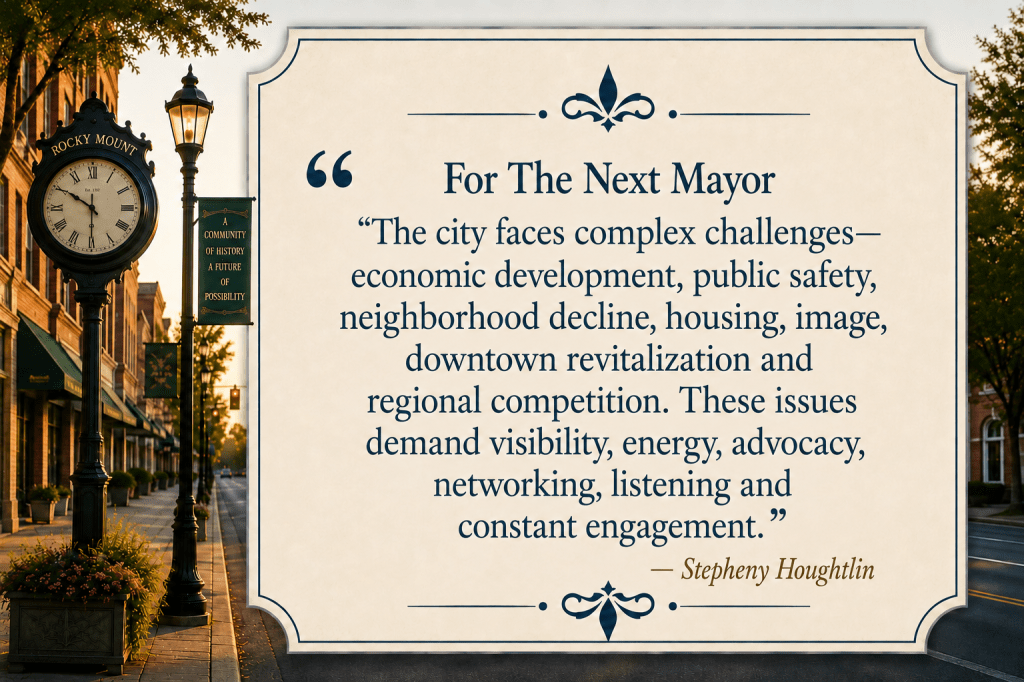
Rocky Mount faces complicated challenges involving economic development, public safety, neighborhood decline, housing, image, downtown revitalization, and regional competition. These issues require visibility, energy, advocacy, networking, listening, and constant engagement.
Modern cities increasingly depend upon mayors who serve not only as presiding officers, but as ambassadors, recruiters, coalition builders, advocates for investment, and visible champions for their communities. Rocky Mount will continue needing those qualities in the years ahead, perhaps more than ever.
Mayor Roberson has devoted substantial time and energy fulfilling many of those responsibilities, and has demonstrated how valuable active mayoral engagement can be to a city seeking growth and revitalization.
That is why the conversation surrounding the 2027 election matters.
As Rocky Mount looks toward its next chapter, as mayoral candidates emerge, we need to ask, will this candidate be equipped to meet the growing demands and opportunities facing the city today?
If we underutilizing a mayor’s influence this is a costly mistake. I think often of Charleston Mayor Joseph Riley and all he accomplished serving as Charleston’s ambassador, helping guide one of the most admired preservation and revitalization success stories in America.
(You can read more here:
https://mainstreetrockymount.com/2026/02/10/still-waiting-beyond-ribbon-cuttings-the-mayor-who-changed-charleston/ )
I am encouraged that conversation about Rocky Mount’s future mayor is underway. I add these thoughts to yours in the hopes that someone spectacular arises, not politically motivated, not beholding to the past, but brand new and ready to roll.
The next mayor of Rocky Mount will inherit far more than a title or a seat at the council table. That person will inherit neighborhoods needing attention, businesses deciding whether to invest, young families deciding whether to stay, historic buildings still waiting for purpose, and a city continuing to decide what kind of future it believes possible.
That is why this discussion matters now, and why I am writing about it here on the Main Street blog.
Today in Rocky Mount there are already men and women attending meetings, volunteering, mentoring children, serving on boards, walking neglected streets, or studying ways to improve this city who have never once imagined themselves as mayor. I think particularly of the many fine professional men and women involved with the Chamber of Commerce, a true breeding ground for future civic leadership.
Rocky Mount’s next chapter begins when citizens begin asking themselves a simple question:
If not now, when? And if not us, who?


Field Marshall Montgomery: Leadership – The capacity and the will to rally men and women to a common purpose and the CHARACTER that inspires confidence.
LikeLike