Among all the personalities I have encountered in my Passwords project, no one has impressed me more than George C. Marshall.
Perhaps that is because Marshall was not the kind of leader who dominates headlines today. He was not loud. He was not theatrical. He did not seek attention. He never built a following around himself.
Instead, he built things.
He built preparedness before a war.
He built confidence during a war.
He built peace after a war.
President Harry Truman called him “the greatest living American.” Winston Churchill called him the “organizer of victory.” History remembers him as the architect of the Marshall Plan, the effort that helped rebuild Europe after World War II. Yet the more I read about Marshall, the more I believe those accomplishments were merely the visible evidence of something deeper.
Marshall possessed a quality that seems increasingly rare.
He anticipated.
He looked around corners.
While others debated, Marshall prepared. While others waited for events to force action, Marshall studied problems, organized resources, and developed solutions.
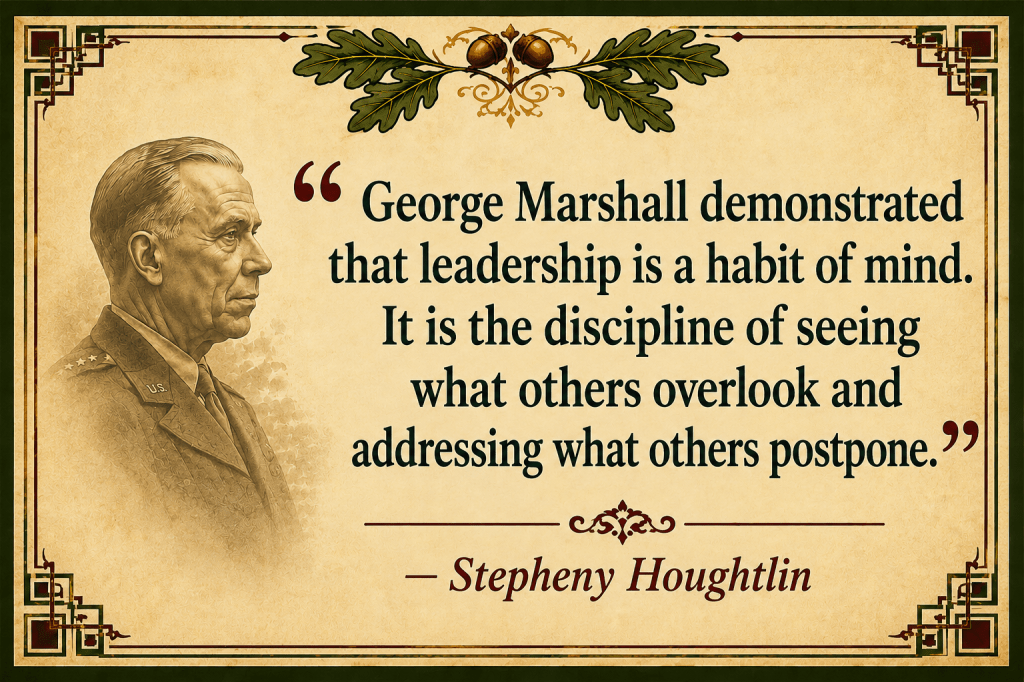
He understood that leadership is not reacting to a crisis. Leadership is recognizing a crisis while it is still small enough to prevent.
The older I get, the more convinced I become that the difference between successful organizations and struggling organizations, successful cities and declining cities, is often found in a single question:
Are the people in charge anticipating problems, or are they merely reacting to them?
Our city has many strengths. We have dedicated citizens, remarkable history, beautiful neighborhoods, generous people, and opportunities that many communities would envy.
Yet we also have challenges that are visible to anyone willing to drive through every neighborhood, walk every commercial district, or simply pay attention.
These challenges did not arrive overnight.
Nor were they hidden.
The condition of certain properties, the deterioration of some neighborhoods, neglected infrastructure, vacant buildings, and other issues have been visible for years.
What troubles me is not the existence of problems. Every city has problems.
What troubles me is the appearance that action often comes only after citizens complain, photographs are published, questions are asked, or public attention becomes impossible to ignore.
George Marshall would have understood the difference. Management reacts. Leadership anticipates. A manager waits for a complaint. A leader notices the problem before the complaint arrives. A manager responds when pressure becomes unavoidable. A leader acts because responsibility requires it.


great article.
LikeLike
Often when one repeats the same negative action over and over it becomes a habit; usually lasting a lifetime.
As children most of us learned to understand the difference between accountability and lack of accountability. If you failed to learn this basic concept life became more difficult, people grew to distrust you and employers terminated you. It was a simple lesson learned from our grandparents, parents, older siblings and in school. Each of us knows a few people who fall into the category of not learning this concept. Consequently, they live an unproductive if not unpleasant life.
I was fortunate to travel frequently with my Grandmother LaVerta from childhood to adult. As we traveled, she pointed out accountability and unaccountability in people we encountered along the way. LaVerta often used these encounters to underscore her expectation of me, the greatness of others and the failures of others. Each encounter was a lesson in life, and she would often point her finger and say “Roddy, it is best to strive towards then to sit and wait.” How true her words were. As I navigate my adult life and my career it proves to be true.
For Rocky Mount it is best for the voters to “strive towards” a solution then to “sit and wait” for someone to fix the city. Each of you has the ability to make a change by asking questions, demanding accountability and stive towards honest leadership and economic stability. To “sit and wait” is a lack of accountability to “act” is accountability.
Roddy
LikeLike