Following the state audit, in meeting rooms, at the kitchen table, and across social media, Rocky Mount has turned to questions of leadership and oversight.
I’m interested in how leaders are formed before they ever step into responsibility, what expectations shape them, what habits of mind they bring when decisions begin to matter, and what we should reasonably expect of them once they arrive.
I offer the following as part of the conversation we are now having.
In my reading life, I have spent a great deal of time with the men who came of age in an earlier America, men shaped by preparation long before they stepped into public life.
They moved through schools and universities like Harvard University, Yale University, and Princeton University, carrying with them not only opportunity, but expectation. There was an understanding, sometimes spoken, often simply absorbed, that those who had been given much were expected to serve.
It was a system that set a high bar. Preparation came first. Responsibility followed.
And at its best, it produced men who believed that leadership was not a reward, but an obligation.
I offer as an example from my reading, three men I deeply admire for their leadership to the country, raised to serve as I have already described. One sees it in George H. W. Bush, the 41st President of the United States. From his privileged upbringing and with high expectations placed upon him, he did not disappoint.
One sees it in George F. Kennan, the diplomat and architect of America’s Cold War strategy, who brought intellect and restraint to the great questions of his time.
And one sees it in Dean Rusk, Secretary of State during the Kennedy and Johnson years, whose steady presence reflected a belief that public service was not performance, but responsibility carried over time.
They did not always get it right.
We have only to look at the remarkable group of men gathered by John F. Kennedy when he became President. They were talented, educated, confident, and yet they did not step back to reconsider the ten years of American involvement already underway in Vietnam. Instead, they accepted the existing approach and carried it forward. Preparation and a shared background did not guarantee wisdom.
It is fascinating how the shared experience of the men I’ve mentioned, often strengthened by the same college under-pinning, met again in Washington and across the world, living out their destiny to lead.
The old path assumed that responsibility would follow privilege. That those who were prepared would understand, before they arrived, that leadership carried weight, and that weight would one day have to be borne.
Today, the path is different.
The country no longer produces its leaders from a single set of schools or families. The preparation is less uniform, the expectations less clearly defined, and at times, the results have reflected that loss of structure.
And yet, new figures step forward..
Men like J. D. Vance and Marco Rubio do not come from the same inherited world. One rises from a difficult Appalachian childhood and finds his way, later, into institutions like Yale Law School, not as a continuation of family expectation, but as a break from it. The other is shaped by an immigrant story, where advancement is earned step by step, not assumed.
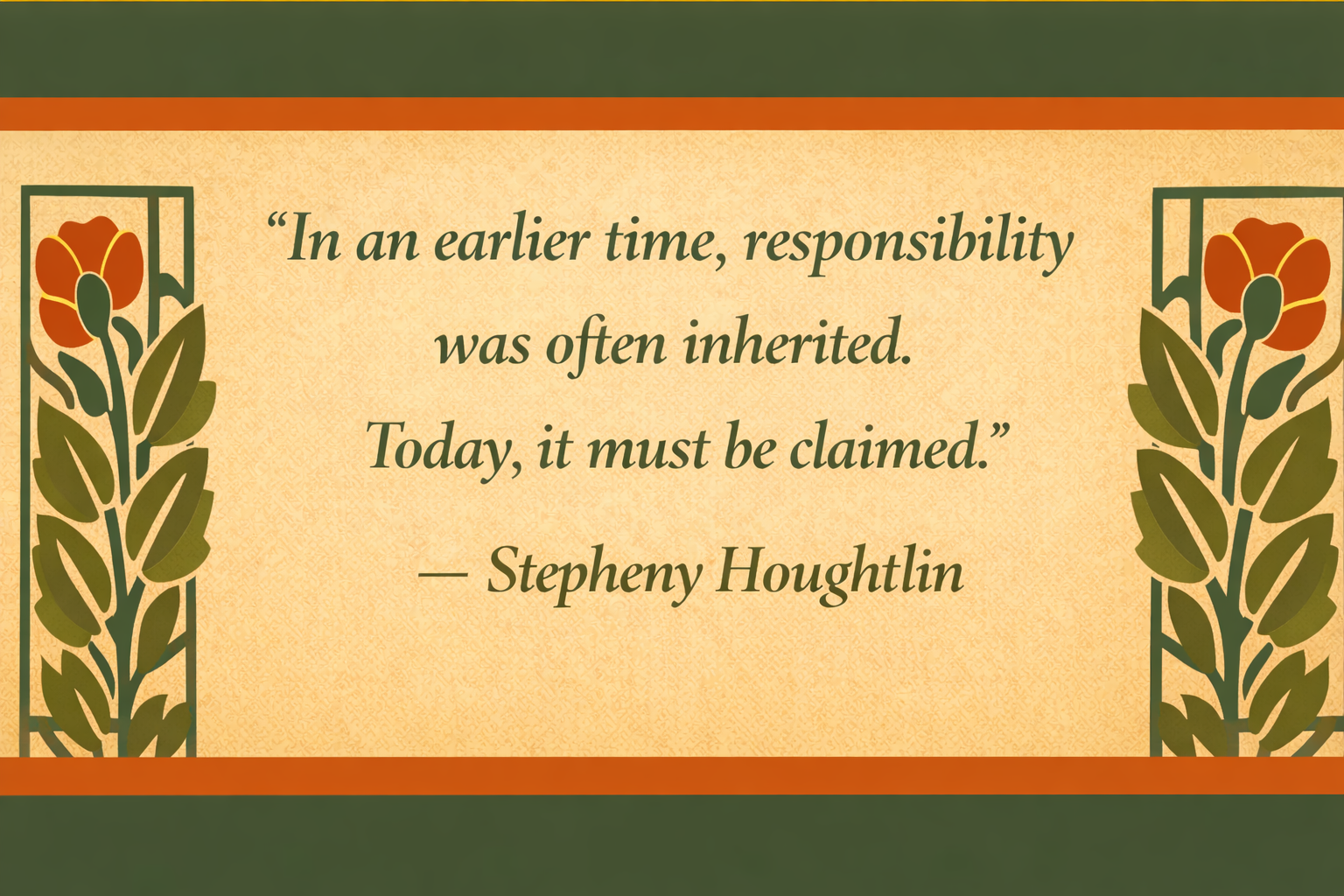
In an earlier time, responsibility was often inherited. Today, it must be claimed.
The country has always depended on the character of those who step forward to lead. Men who seem to understand that leadership is not a prize to be claimed, but a responsibility to be carried.


I expect the insanity to continue. You know the old saying: “Insanity is doing the same thing over and over and expecting different results”.
LikeLike