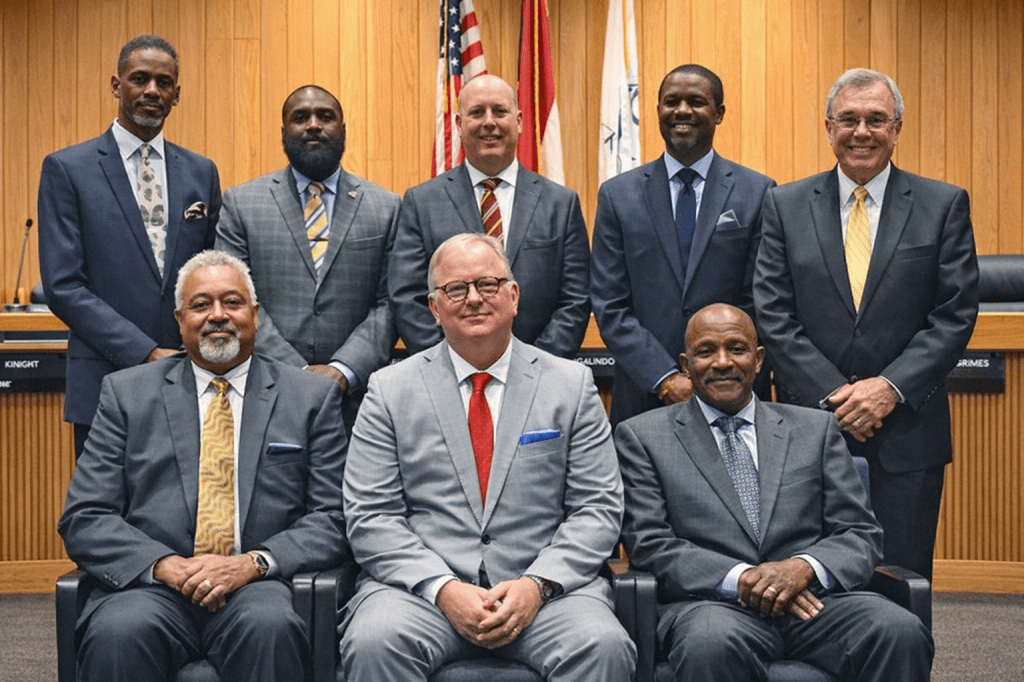
What has unfolded in Rocky Mount over these past weeks has been a civic burden for everyone. The audit’s language, a lack of leadership, a lack of oversight, has stirred more than concern.
It has stirred a kind of impatience. You can feel it in the conversations, and certainly across social media, where the question has already moved from “what happened?” to “who needs to be replaced?”
This blog is another attempt to broaden the conversation about the role of leadership in Rocky Mount.
Leadership failures rarely begin with a single bad decision. They tend to take shape slowly, over time, in ways that are harder to see while they are happening.
I am reading, The Brothers by Stephen Kinzer about the Dulles brothers, John Foster and Allen. They were not careless men.
The fact that the more I read, the less I like them, does not diminish their significance. Under Eisenhower, John Foster Dulles was Secretary of State and Allen Dulles head of the CIA.
They were disciplined, informed, and deeply committed to what they believed was right. But as their thinking settled around a single, central idea, that communism was the defining threat of their time, something else began to happen.
Their field of vision narrowed.
Different places, different conflicts, different circumstances began to look the same. Not because they were the same, but because they were being viewed through the same lens. And when that happens, the need to ask new questions begins to fade. You are no longer discovering what is in front of you. You only see what you already believe to be there.
That thought followed me out of the book and into the present moment.
Currently Senator Rand Paul of Kentucky has been in the news standing apart in a debate over a federal spending bill he has declined to support. Watching that unfold while reading about the Dulles brothers, brought an ‘aha’ connected for me.
Not a comparison of men. Not a judgment of positions.
A pattern.
A way of seeing.
In Rand Paul’s case the organizing idea is not communism, but is a deep and consistent belief about government, spending, and individual liberty. But like the Dulles brothers, Rand Paul has come to a single explanation for most issues. Different problems have become one in the same.
When a way of seeing becomes a certainty, we are no longer interested in alternatives, or the questioning of our rightness in the matter. It is a settled business,
The particulars of a situation, its nuances, its exceptions, can lose their place. Over time, decisions begin to follow the framework that one size fits all.
Understanding how the Dulles brothers came to see the world helped me recognize the same narrowing of the lens in Rand Paul certainties. And, became another way to look at Rocky Mount’s City Council.
Because whatever conclusions people reach about the Council, there are other concerns that go beyond who is sitting in those seats.
It is whether the habit of inquiry will be tolerated when the Council meets.
Are decisions being shaped by careful attention to what is actually in front of them, or by a fixed way of seeing that has already decided what each situation must mean?
When any single lens becomes dominant, every issue begins to pass through it. Different circumstances no longer ask to be understood on their own terms because they have already been interpreted in advance.
Within Rocky Mount’s City Council, there are moments when that lens appears to be race. When that happens, disagreement is too quickly explained away as racism.
A settled conclusion interprets everything in its own image. Once that explanation takes hold for a person, to question it becomes unnecessary. Not all, but some of the councilmen don’t want to answer any questions, period. They talk around most anything that doesn’t suit them.
Knowing we are in big financial trouble, fixing the framework of the council is part of the answer.
I offer this not as a conclusion, but as something worth thinking about, because leadership depends, above all, on the willingness to keep asking what is true, not simply what fits.

 Main Street Rocky Mount
Where are the women?
LikeLike
Ruth Bader Ginsburg
“Women belong in all places where decisions are being made.”
Thanks for leaving your comments. I think you will like my reply. Stepheny
LikeLike
An excellent description of the root problem that many of our current governing entities have. Thank you.
LikeLike