“Art is not a luxury. It stands at the essence of our humanity…” Salman Rushdie
On this Main Street blog, I write about buildings, their beauty, their endurance. They tell us what a town once believed about itself, and ask what we believe now.
But architecture is only one part of a living Main Street.
Art is another.
When I look at downtown Rocky Mount today, I see an art scene that is expanding. It is not imagined or aspirational. It is real.
Salman Rushdie reminds us that art is not a luxury. That distinction matters. Too often, especially in towns working hard to stabilize themselves, art is treated as something extra, something to tend to after the practical work is done.
But art is not the icing. It is part of the structure. It is how a community expresses its values, invites participation, and reminds itself that life is meant to be lived fully.
Many towns our size would give anything to have a place anchoring their cultural life.
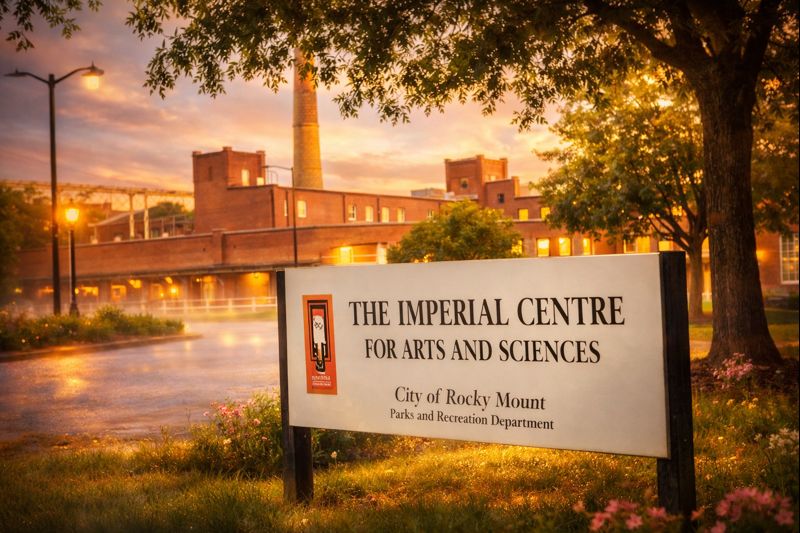
We do. The Imperial Centre for the Arts and Sciences is not an accessory to downtown Rocky Mount. It is an essential civic asset.
Housed in a beautifully repurposed industrial building, the Imperial Centre already does important work, visual arts, performances, education, and community programming.
From a civic perspective, it works best when it is fully integrated into the daily rhythm of Main Street. It already holds the essential ingredients: a central location, a trusted presence, and a mission that invites people not only to attend, but to return.
When cultural places become part of everyday routines, woven into how we meet, linger, and mark time, they move from being destinations to becoming anchors of civic life.
I’m reminded of the restaurant that once operated inside the museum. It became a favorite rendezvous, a place to meet a friend or hold a small meeting. It slipped easily into my routine and, almost without noticing, carried me through the museum doors as part of that visit.
I still wish for that kind of opportunity again, not out of nostalgia, but because it demonstrated how cultural institutions thrive when they are woven into daily patterns of use, not reserved solely for special occasions.
Participation in cultural life does not begin with marketing alone. It begins with a shared understanding that this is our place, and that returning to it, supporting it, and speaking about it are part of civic belonging.
This observation is not a dismissal of effort. It is an acknowledgment of unrealized potential.
An arts centre should feel like a light left on. Something you notice, enter, and return to. A steady presence that becomes familiar over time, not because it demands attention, but because it earns it.
When that happens, downtown becomes more than a destination. It becomes a habit.

 Main Street Rocky Mount
I aree with all above comments We need to fight fight fight
LikeLike
Thanks for leaving your comment and keeping me company by reading the blog. It is High Alert time and indeed, we must fight, fight, fight. Stepheny
LikeLike
l agree 💯 percent. Rocky Mount let’s work hard to keep the Imperial Center open and thriving.
LikeLike
Thanks for leaving your comment. The Imperial Center must not pay for the lack of oversight that has gone on. ‘Open and Thriving’ is the new bumper sticker. Stepheny
LikeLike
Thanks, Stepheny, I can’t and don’t want to imagine life in Rocky Mount without The Imperial Centre.
LikeLike
Thank you for leaving your comment! Together we will IMAGINE The Imperial Center strong and growing in the our civic life. Stepheny
LikeLike
What if all the thieves posing as council members are prosecuted and their assets seized and liquidated? That would be a start. What about hiring a City Manager that is not an embezzler? A good second step. What about voters voting for individuals who actually have the skill set to oversee a city? A good third step. And, so on. . .
Rodd
LikeLike
Your comment ‘what if’ is timely. If only your suggestions come true. I’m glad you continue to chime in on ROcky Mount. You would LOVE all the great food that is now available. As for the ‘troubles’ they are still with us. Stepeheny
LikeLike
Sell the event center (to event management company that can make it profitable and will pay taxes), terminate council pay, administration pay senior manager and above no more than 150,000, all other managers 10% reduction, cancel all entertainment programs, sell casino land, replenish reserve fund, forgive/reimburse citizens for second dec bill.
LikeLiked by 1 person
Thanks for offering suggestions on how we fix the audit findings. You get a star in your crown from Mainstreet.
LikeLike
I love your ideas. I have written more on Concerned Citizens about a way to address the event center. Thank you for offering these good solutions to the discussion of how to fix this.They should be considered. Stepheny
LikeLiked by 1 person