In recent weeks many readers have asked a direct question as the conversation about changing how Rocky Mount votes continues to grow. What would city-wide voting actually look like in practice?
Right now council members are chosen by ward. Candidates come from one of the seven wards, and only voters who live inside that ward decide who represents them.
The system was created to ensure neighborhood representation, and that part does not disappear simply because the voting method changes.
A city-wide voting structure keeps the idea of local representation, but expands who has a voice in choosing leadership. Council members would still come from specific wards, they would still live in those communities and understand the streets they serve.
What changes is not where candidates come from, but who participates in selecting them. Residency defines who can run, city-wide voting defines who chooses.
Under this approach every voter would see each council race on the ballot. A candidate from Ward Three would still represent Ward Three, but residents across Rocky Mount would take part in deciding who sits at the council table.
The purpose is not to erase neighborhood identity, it is to strengthen the expectation that every council member serves the entire city once elected.
Some readers have asked an important practical question, what happens if only one candidate comes forward for a ward seat. Even under city-wide voting an unopposed candidate may still appear on the ballot or be declared elected depending on election rules.
What changes is the level of public accountability. Instead of a limited electorate deciding the outcome, the entire city evaluates the person who will help shape its future. The circle of responsibility grows larger, and the path for future challengers is no longer confined to a single ward.
Even when only one candidate files for a ward seat in Rocky Mount, the election is still held and voters may cast write-in votes. However, for a write-in vote to count, the individual must have properly qualified as a write-in candidate under North Carolina election law.
Votes for someone who has not filed the required paperwork are not tallied. In the end, the winner is determined by who receives the highest number of valid votes, including any qualified write-in votes. In other words, even an unopposed candidate is not automatically appointed; the voters still have the opportunity to choose, and the totals decide the outcome.
City-wide voting does not promise instant change, and it does not guarantee new personalities. What it does offer is a structural shift toward shared responsibility.
Campaigns begin to speak to broader concerns, leadership is measured against the needs of the whole city, and voters gain a voice in every seat that shapes Rocky Mount’s direction.
This conversation is not about removing local voices, it is about strengthening the bond between representation and stewardship.
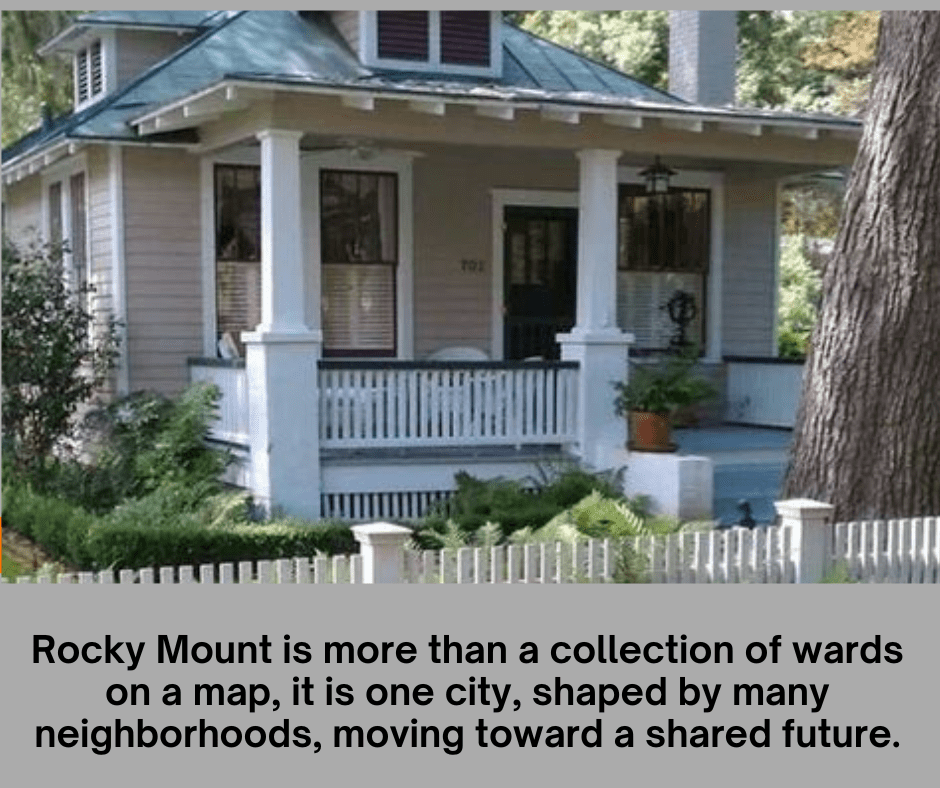
Rocky Mount is more than a collection of wards on a map, it is one city, shaped by many neighborhoods, moving toward a shared future.
The question before us is whether the way we vote should reflect that reality.
Stepheny Forgue Houghtlin grew up in Evanston, IL. and is a graduate of the University of Kentucky. She is an author of two novels: The Greening of a Heart and Facing East. She lives, writes and gardens in NC. Visit her: Stephenyhoughtlin.com
View all posts by Stepheny Forgue Houghtlin

 Main Street Rocky Mount