Lost in the Outcry Loop: After the Latest City Council Meeting


After the latest City Council meeting, the same thing happens. The comments on social media fill up. Frustration spills over. The words are familiar, Enough. Remove him. How is this allowed?

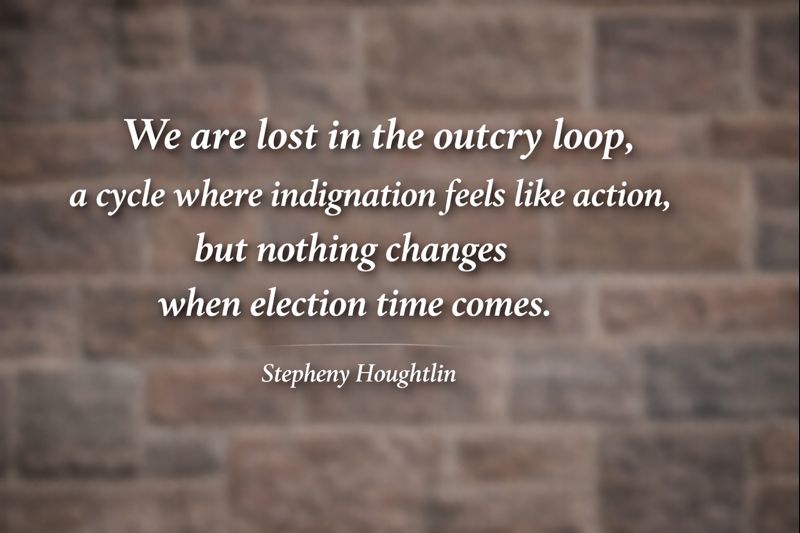
We are lost in the outcry loop, a cycle where indignation feels like action, but nothing changes when election time comes.

This is not because people do not care. It is because outrage, on its own, does not produce results, does not build an alternative.

Andre Knight’s repeated appearances in the news, followed by repeated reelections, are not a mystery. They reveal a pattern where any opposition is a day late and a dollar short.

Bad actors persist in public office for predictable reasons. Not because their behavior is admirable, but because opposition is fragmented, inconsistent, and reactive.

Outrage arrives after damage is done. Elections, by contrast, reward familiarity. A known name, even a troubled one, often prevails over diffuse dissatisfaction that has no strategy or preparation for change.
Social media intensifies this imbalance. Comment threads create the illusion of momentum, but they do not translate into sustained civic work. The energy is real, but it is scattered. By the time ballots are cast, the machinery that produced the outcome remains firmly in place.

This is how communities become stuck, deeply dissatisfied, highly expressive, and politically unchanged.

This post is not about revisiting incidents or adding to the noise. It is about naming why the outcry loop feels satisfying yet fails to deliver results. Change does not begin with protest alone. It begins now in this New Year with intention, and engagement long before an election demands attention.

Until frustration is converted into something deliberate and sustained, the outcry loop will continue, producing the same disbelief, followed by the same outcome.

Outcry may feel like engagement, but without direction it becomes a loop, familiar, expressive, and ultimately ineffective. Naming that pattern is necessary, but it is not sufficient.

If we are serious about changing outcomes rather than reacting to them, the conversation has to move beyond frustration and toward what happens in the long stretch between elections.

That is where attention either deepens into preparation, or fades back into noise.

The next post tomorrow 1-11-25 turns to why waiting until election season is too late.

Leave a comment