The Samuel-Novarro House: Two Faces of an Icon – Art Deco Form

Our Art Deco journey takes us to Los Angeles, 1928. Picture the golden age of Hollywood: silent film stars, lavish sets, and a city inventing itself as a modern capital of style.

In the midst of it all, Frank Lloyd Wright Jr., the son of America’s most famous architect, designed a house that still turns heads nearly a century later.

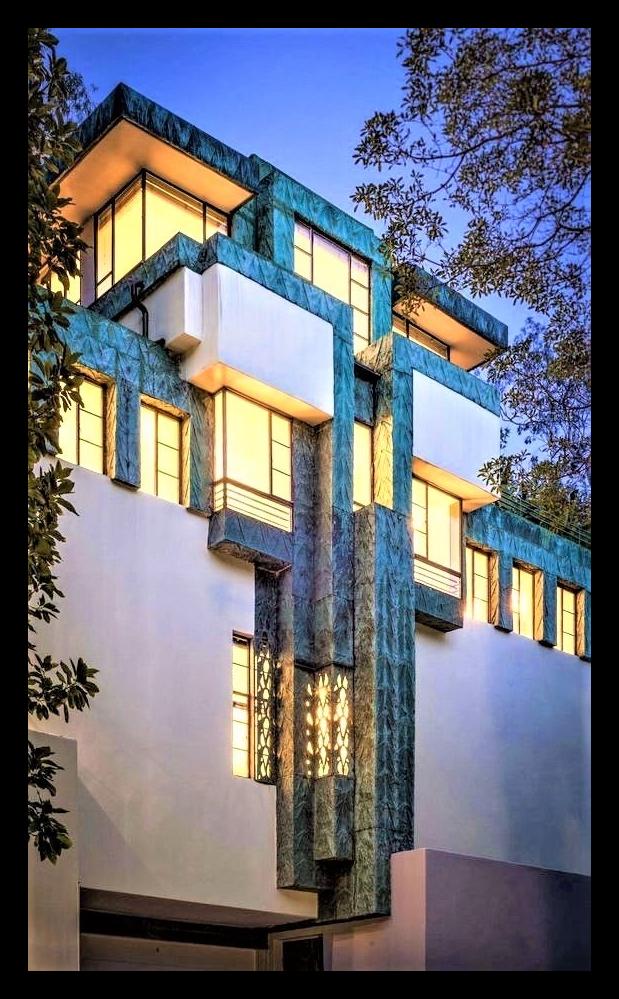
The Samuel-Novarro House rises like a sculptural temple in the Los Feliz neighborhood, with bold vertical lines and turquoise-green copper panels playing against stark white walls.

Known for its striking Art Deco geometry and copper-clad surfaces, it has long captured the public imagination. Its layered volumes, illuminated windows, and vertical spine of oxidized copper make it one of the most photographed and admired homes in the city.

It is part of what’s known as the Mayan Revival style, a branch of Art Deco inspired by the monumental forms of ancient civilizations. At night, the house glows from within, its banded windows casting a lantern-like light across the hillside.

The story of the house is pure Hollywood. Originally built by Louis Samuel, personal secretary to silent film star Ramon Novarro, it soon passed into Novarro’s ownership. For years, he lived here in glamour and secrecy, one of the screen’s most admired leading men.

Later, the house fell into disrepair, but it has since been restored and recognized as a Los Angeles Historic-Cultural Monument.

But what we often see in glossy magazines or coffee table books is only one face of the house, the celebrated canyon-facing facade, glowing with theatrical beauty.

Yet architecture, like people, is rarely one-dimensional. The photograph above shows something different: the rear elevation, the hillside-facing approach with its garage entry. At first glance, it feels plainer.

But look closer. The same copper spine runs down the center, the same geometric detailing is there, and the windows still punctuate the design with Wright’s characteristic rhythm.

This perspective is less public, less celebrated, but no less important. It reveals the house’s balance between the practical and the theatrical, between the daily life of its residents and the stage set it presents to the world.

Together, these two views tell a fuller story. One side dazzles with copper and light; the other provides the quiet entry where life unfolds. Each is essential, and together they embody what makes the Samuel-Novarro House an enduring work of art.

Houses, like people, have their polished side and their quieter side. The Samuel-Novarro House reminds us that both belong to the story. We cherish the beauty that dazzles, but we should not forget the quieter rhythms that sustain it.

Why does this matter to us in Rocky Mount? Because learning to see a building like this helps us expand our architectural vocabulary. We begin to understand how design styles move across time and place, how they capture the mood of an era, and how they can even tell us about the dreams and desires of the people who built them.

The Samuel-Novarro House is more than a residence, it’s a story in stone, copper, and light. It teaches us that architecture can be both a home and a work of art. And in that way, it belongs to all of us who care about honoring the past and building a future.

As we close today’s look at this remarkable building, it feels like a class, one where we are learning the language of Art Deco, one building at a time.

Let’s pause here, students of Main Street and beyond. The next lesson is waiting, and with it another example of Art Deco architecture to study, admire, and carry with us as we continue learning together.

Leave a comment