
The courtroom doors swing shut. The jury settles in. The prosecutor rises. A witness, sworn in for his expertise, takes the stand. Papers shuffle, silence grows thick, and the questioning begins.
The Testimony
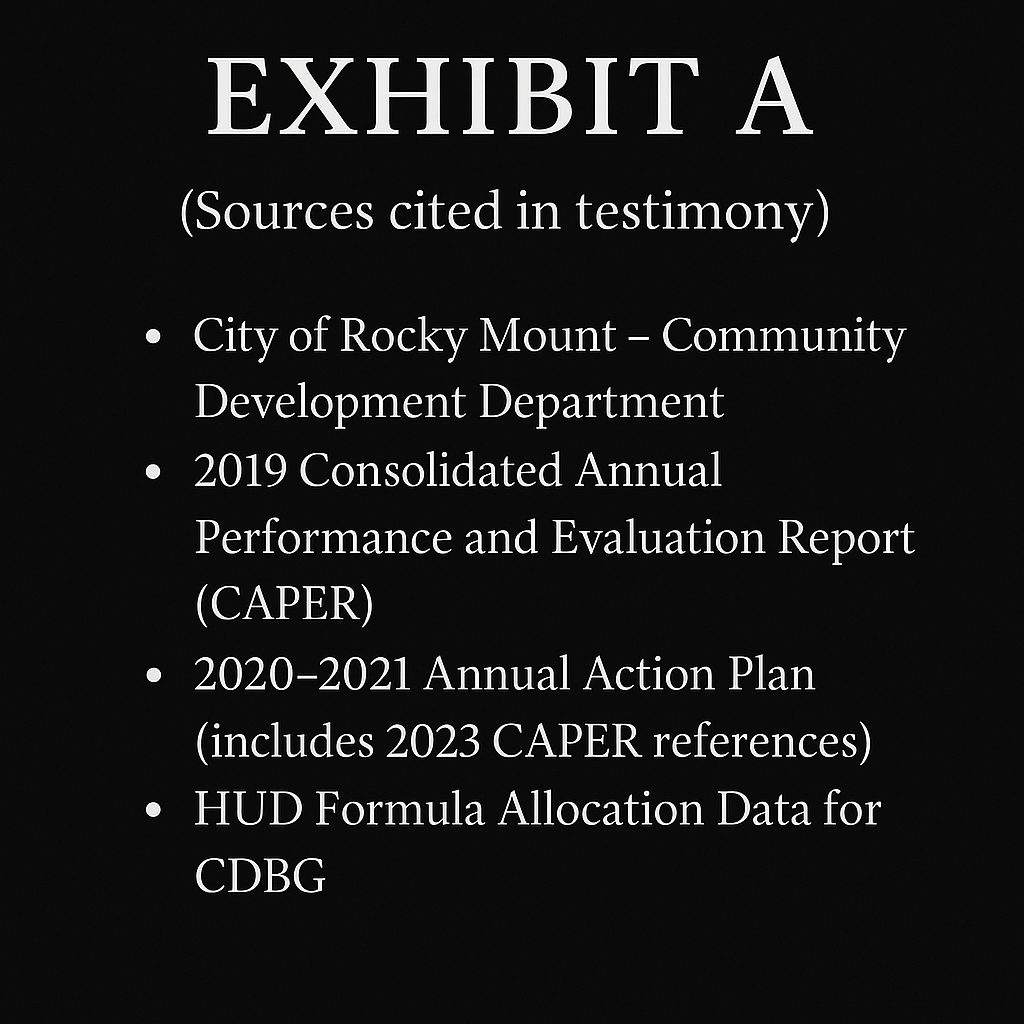
Prosecutor: “Mr. Witness, for the record, can you explain what the city’s 2019 CAPER reported about housing repairs?”
Witness: “Yes. The 2019 Consolidated Annual Performance and Evaluation Report shows the city completed 19 urgent home repairs and 23 general housing repairs. However, the report does not specify how many of those were in Ward 1 or Ward 2.”
Prosecutor: “And when we look at the 2023 CAPER, what does it tell us?”
Witness: “The 2023 report records that 129 homeowners received housing rehabilitation assistance, 2 families received homebuyer assistance, and 13 families transitioned into permanent housing through supported services. These are the official figures. But again, the numbers are presented citywide, with no ward-by-ward breakdown.”
Prosecutor: “Does the 2023 CAPER include information on public service grants?”
Witness: “Yes. It reports that $110,535 in Community Development Block Grant (CDBG) Public Service funds were awarded to six nonprofits. But the document does not indicate which neighborhoods were directly served, or whether residents in Ward 1 or Ward 2 benefited.”
Prosecutor: “Let’s step back further. What has Rocky Mount typically received in federal CDBG entitlement funds?”
Witness: “HUD entitlement data shows Rocky Mount receiving allocations in the range of $804,000 to $1.3 million annually over the past decade. These funds are earmarked for housing, infrastructure, and neighborhood revitalization.”
Prosecutor: “And when the city budgets those funds, where are they supposed to go?”
Witness: “For example, the 2020–2021 Annual Action Plan budgeted $526,640 in CDBG, including $164,316 for redevelopment projects and $50,000 for housing rehab delivery. The target areas listed included Down East, Holly Street, Central City, and Southeast Rocky Mount—areas overlapping Ward 1 and Ward 2. But the reports do not tell us how much work was completed in those wards.”
Prosecutor: “What about more recent plans?”
Witness: “The current 2025 Annual Action Plan projects $495,363 in CDBG and $359,420 in HOME funds, with a goal of 16 homeowner rehabs this cycle. But again, the plan does not identify how many of those homes are in Wards 1 or 2.”
Prosecutor: “What can you tell us about public housing?”
Witness: “The Rocky Mount Housing Authority reports managing 744 public housing units, with voucher waitlists running 1 to 4 years. But public reports don’t break down how many of those units are in Wards 1 and 2, nor what progress has been made to rehabilitate them.”
Prosecutor: “So if I understand you, Mr. Witness, the record shows funding, the programs are reported, but we cannot verify if Ward 1 or Ward 2 residents actually saw the results?”
Witness: “Yes. Based on the public documentation, that is correct.”
Prosecutor: “Based on your review of the records and your own observations, how would you summarize the impact of these housing and grant programs?”
Expert Witness:
“The testimony is clear: the funds are real, the programs exist, the reports are filed. Yet a drive through a neighborhood like Happy Hill, redistricted to Ward #2, reveals a different reality, boarded windows, neglected awnings, missing porch rails, and talk that has not translated into action.
In effect, the system has produced a cycle of eligibility without progress. Each new award depended on neighborhoods remaining poor enough, broken enough, to qualify again.
Genuine improvement would have disrupted that formula.
The evidence shows a pattern: communities reduced to leverage, their hardship converted into numbers on grant applications, their condition maintained rather than lifted. This is not the random result of neglect. It is a consistent outcome, observable across years of reporting.”

 Main Street Rocky Mount